





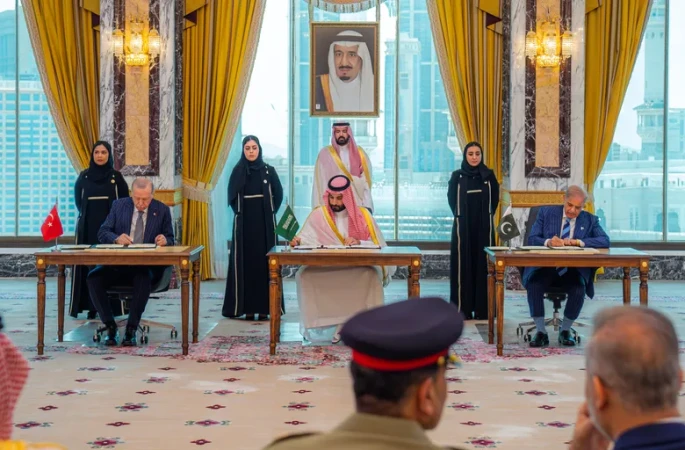
MECCA, Saudi Arabia : Saudi Arabia, Türkiye and Pakistan have signed a landmark trilateral defence agreement in Mecca, bringing together three major Muslim-majority powers amid heightened tensions across the Middle East and uncertainty surrounding the future of the Strait of Hormuz.
Saudi Crown Prince Mohammed bin Salman, Turkish President Recep Tayyip Erdoğan and Pakistani Prime Minister Shehbaz Sharif signed the Mecca Joint Defence Agreement on Friday, August 7. The pact is intended to strengthen collective security and deterrence among the three countries as the region faces growing military and geopolitical pressures.
The agreement reportedly establishes a principle of mutual defence under which aggression against one member would trigger a collective response from the other two. However, officials have emphasized that the pact is defensive in nature and is not directed against any particular country. The precise military obligations and mechanisms for responding to an attack have not yet been publicly detailed.
The deal comes at a particularly sensitive moment for the region, with tensions involving Iran, Israel and regional armed groups continuing to threaten security and trade routes. The Strait of Hormuz, one of the world's most strategically important energy corridors, has also become a major focus of international diplomacy as discussions over a possible deal to ease tensions and restore shipping continue.
A New Regional Security Framework
The agreement brings together countries with significant but different strategic capabilities. Saudi Arabia provides substantial financial and energy resources, Türkiye has one of the region's largest and most capable military and defence industries, while Pakistan contributes extensive military experience and is the world's only nuclear-armed Muslim-majority state.
The three countries already maintain longstanding defence and security relationships. Pakistan and Saudi Arabia have particularly close military ties, while Türkiye and Pakistan have expanded defence cooperation in recent years, including military equipment and joint exercises.
Analysts say the new agreement could contribute to a more regionally driven security architecture at a time when traditional security arrangements are under pressure. The pact could also strengthen coordination in areas including intelligence sharing, military cooperation and strategic deterrence.
Hormuz Talks Add to Significance
The timing of the Mecca agreement is particularly significant as international efforts continue to address the crisis surrounding the Strait of Hormuz.
The waterway is a crucial route for global energy supplies, and disruptions could have consequences far beyond the Middle East. European governments have been cautious about joining a proposed US-led naval mission in the area, with officials emphasizing the need for de-escalation and diplomatic solutions.
Against this backdrop, the new Saudi-Türkiye-Pakistan defence arrangement could give the three countries a stronger collective position as regional powers seek greater control over their own security arrangements.
Officials Stress Defensive Nature
Despite speculation that the agreement could mark the emergence of a new regional military bloc, officials from the three countries have sought to characterize the pact as defensive rather than offensive.
The agreement does not publicly establish a NATO-style military command, and significant details about how the three countries would respond to a military attack remain unclear. Pakistan has also indicated that the agreement should not be interpreted as a move toward nuclear cooperation with Saudi Arabia.
Nevertheless, the signing represents a significant development in the region's evolving security landscape. With tensions continuing to affect the Middle East and strategic waterways such as Hormuz remaining vulnerable, the pact could have far-reaching implications for regional alliances and the balance of power.
The Mecca agreement therefore marks not only a deepening of defence ties between Saudi Arabia, Türkiye and Pakistan, but also a broader push by regional powers to develop their own collective security mechanisms amid an increasingly uncertain geopolitical environment.