





KATHMANDU: The Government of Nepal has initiated a comprehensive drive to revitalize ailing public institutions and state-owned enterprises (SOEs), placing continuous facilitation, motivation, and inter-agency coordination at the heart of its policy agenda. According to a major progress report released by Prime Minister Balen Shah, these targeted interventions, strict adherence to legal frameworks, and disciplined management have already delivered encouraging turnaround results across several key national industries.
Addressing public concerns over long-shut and loss-making industries, Prime Minister Balen Shah stated:
"For years, many doubted whether our public industries—shut down, burdened by losses, and surrounded by despair—could ever stand on their own feet again. Such doubts were natural. However, when intentions are clear and honesty is shown toward responsibility, new doors of reform open even in the most challenging situations. Through honest effort, strict enforcement of law, and continuous teamwork, promising results are beginning to emerge."
Key Progress and Turnaround Highlights Across State Enterprises
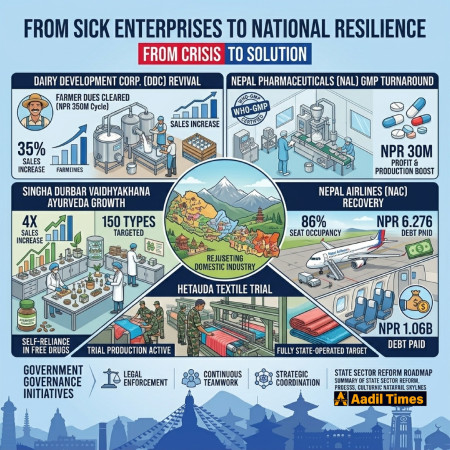
1. Nepal Pharmaceuticals Limited (Nepal Aushadhi Limited)
After suffering chronic financial losses for years, the national pharmaceutical enterprise has staged a remarkable recovery following its attainment of the World Health Organization’s Good Manufacturing Practice (GMP) certification:
Revenue & Profits: Recorded drug sales of NPR 23.8 million in the last four months alone. Boosted sales enabled the company to achieve a net profit of NPR 30 million in the previous fiscal year, with an ambitious revenue target of NPR 300 million set for the current fiscal year.
Free Medicine Production: Under the government’s 100-point governance reform roadmap, the enterprise aims to manufacture 98 types of essential free medicines within three years. For the current fiscal year, preparations are in the final stages to produce 25 out of 37 targeted medicine types. Currently, 11 types are actively manufactured.
2. Hetauda Textile Industry
The long-defunct Hetauda Textile Factory has officially resumed initial operations following critical technical repairs:
Trial Production via Nepal Army: The responsibility for trial production was entrusted to the Nepal Army. Following successful maintenance and repair of the weaving looms, trial production has commenced, with textile production officially underway.
State Operations: Following the successful completion of the testing phase, the Government of Nepal will assume full operational management of the factory.
3. Nepal Airlines Corporation (NAC)
The national flag carrier demonstrated a robust operational and financial recovery during the third and fourth quarters of the last fiscal year (Chaitra to Asar):
Revenue Growth: Generated NPR 6.276 billion in revenue between Chaitra and Asar—an increase of NPR 1.102 billion compared to the same period in the preceding year.
Occupancy & Debt Servicing: Passenger seat occupancy rose to 86% (up 6% year-on-year). Utilizing improved cash flows, NAC paid off NPR 1.061 billion in loan installments owed to the Employees' Provident Fund and Citizen Investment Trust for aircraft purchases.
4. Dairy Development Corporation (DDC)
Systemic operational restructuring at DDC has restored fiscal discipline, significantly benefited dairy farmers, and opened international export avenues:
Dues Clearance & Farmer Support: Backlogged payments to dairy farmers were drastically reduced from an 8-month cycle (NPR 720 million) down to a 2- to 3-month cycle (NPR 350 million). Additionally, an incentive of NPR 1 per liter was added for dairy farmers.
Sales Surge & Cost Efficiency: Daily milk sales surged by 35%, driving average daily revenue from NPR 6.0 million to NPR 9.0 million. Eliminating unlawful free dairy distributions to staff saved nearly NPR 30 million annually.
Exports & Expansion: Preparations are in the final stages to export ghee to the Gulf region, and butter and 'Chhurpi' (hard cheese) to China. Cheese production is also being reinstated at the Nagarkot center.
5. Singha Durbar Vaidhyakhana Development Committee
The historic state Ayurvedic manufacturing facility has witnessed a four-fold increase in operational output:
Sales Surge: Produced and marketed NPR 111.6 million worth of Ayurvedic products since the new government took office. Annual turnover reached approximately NPR 130 million last fiscal year—a 4x increase over the previous year.
Self-Reliance Goals: Currently produces 105 types of Ayurvedic medicines (targeting 150 types this fiscal year). It is moving toward total self-reliance in producing 35 types of free-distribution drugs.
GMP Standards: Plans are underway to achieve WHO-GMP standards for powder and tablet lines and establish a dedicated processing center for raw herbs and medicinal ingredients.
A Vision for National Self-Reliance
In his concluding remarks, Prime Minister Balen Shah expressed confidence that with honesty and dedication to the country, new life can be breathed into all remaining distressed industries:
"If we maintain honesty and dedication to our nation, our belief that new life can be breathed into our other ailing industries grows stronger. On this journey to increase production from our own soil and guide the nation toward self-reliance, we look forward to everyone's constructive support, encouragement, and trust."